
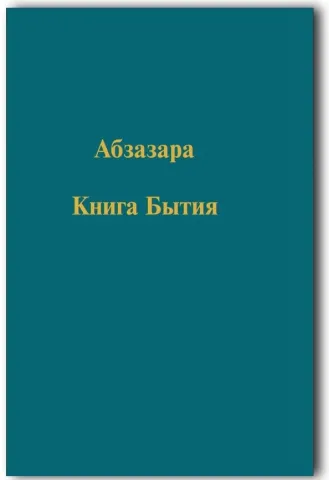
The Institute for Bible Translation (IBT) has released a new edition — the book of Genesis in the Abaza language of the NW Caucasus. The edition was published as a diglot with a parallel Russian text, as well as maps. The print run was 300 copies.
Genesis is the first book of the Old Testament and the opening book of the biblical canon. It presents key narratives of fundamental importance to all Abrahamic religions: the creation of the world, the story of Adam and Eve, the account of Noah and the great flood, the life of Abraham and his willingness to sacrifice his son, the stories of Sodom and Gomorrah, Joseph and his brothers, and others.
During the preparation of this edition, the translation team had to address a variety of challenges. One concept that was new to them was the ancient right of inheritance granting a double portion to firstborn sons — a practice not found in Abaza culture. Another interesting translation decision involved the change of Abraham's wife's name from Sarai to Sarah. The Abaza text uses the forms Sara and Saryat, since both names already exist within Abaza culture.
According to the 2021 census, the Abaza population in Russia is 43,793, of whom 30,194 are proficient in the Abaza language. The Abaza language belongs to the Abkhaz-Abaza branch of the Abkhaz-Adyghe group of Caucasian languages. The historical homeland of the Abaza is considered to be modern-day Abkhazia, from where, due to land shortages in the 13th–14th centuries, they migrated to the northern slopes of the Caucasus mountain range. Today, the majority of Abaza people live in the Abazinsky and Adyge-Khablsky districts of the Karachay-Cherkess Republic, as well as in its capital, Cherkessk.
IBT had previously published several other biblical texts in the Abaza language. The first was a passage from the Gospel of Luke (2:1–20), included in the book The Nativity of Jesus Christ in 80 languages of the CIS (IBT, 2000, pp. 26–27). Also published in Abaza are: the book of the prophet Jonah — a diglot with the CARS (or, Eastern) Russian translation (2019); Ruth and Esther (2020); Gospel Parables (2020); Matthew (2021); Luke and Acts(2023); and Mark (2025).
A PDF version of this edition is available on the IBT website. In addition, Bible apps for Android and iOS are available in the Abaza language, featuring all of the previously published translations.