
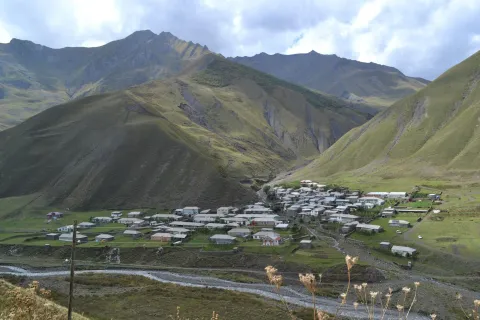
In the village of Archib, the ancestral home of the Archi people, only three families remained for the winter of 2024-25, and even they are planning to move to Makhachkala for the winter months. The village is so remote that staying there for the winter, especially for the elderly, is simply too risky. In an emergency, one could find oneself without necessary help. From Makhachkala to the village of Kuppa, where IBT seminars on oral Bible translation have been held for two years in a row, it is a two-hour and fifteen-minute drive. From Kuppa to Archib is another hundred kilometers, which in reality stretches into a three-hour journey. This is because the road is a winding serpentine through the mountains, partly running through terrain where it’s impossible to pave the road, so there is no proper highway.
It is sad to hear of yet another Dagestani village fading away. However, for the Archi translation project itself, there is also good news: it suits our exegetical advisor just fine that the entire translation team will gather in Makhachkala for the winter. This will spare him the many hours of very difficult, even dangerous, travel.
All or nearly all Archi people speak Avar in addition to their native language. Avar serves as a kind of lingua franca. During Soviet times, it was the language of instruction in the village school. Most, of course, also speak Russian. But it turned out that in the translator’s family, his mother doesn’t know Russian at all. When the exegetical advisor, upon entering the house, greeted her in Archi (he is studying the Archi language under the attentive guidance of her granddaughter), she smiled warmly and informed her family that this man speaks Archi better than her own daughter-in-law. After all, her son’s wife is Avar and doesn’t know the Archi language.
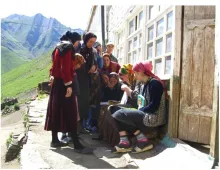
This very granddaughter, a teacher of Archi for translation project participants, is a young woman who has just become a mother herself. She not only serves as a language teacher but also assists as a respondent during field testing. The exegetical advisor conducts this field testing himself. He asks comprehension questions about the meaning of what was heard, and also asks for a “back translation” of the Archi audio recording into Russian (oral Bible translation uses audio recordings, not written texts).
In almost all of IBT’s oral projects, once the final audio is recorded, the text is also transcribed, published in a smartphone app, and eventually published as a printed book. The translation teams themselves insist on this. Although their minority language may not even have an official writing system, it is a matter of special pride for them to see a book with text in their native tongue. However, with the Archi project, it is not yet entirely clear whether a written text of Scripture will be produced. A writing system for the Archi has been developed by Moscow linguists; they even published an Archi-Russian-English dictionary. This can be found both in book format and online. But the Archi people themselves have not adopted the native alphabet. Perhaps this trend will change over time; perhaps IBT’s Archi publications will even facilitate this. After all, the language is endangered; each subsequent generation uses it less and less than the previous one.
For instance, the exegetical advisor tried to ask his teacher what the days of the week are called in Archi, but it turned out she didn’t know these words and had never heard them. She only knows the name for Friday — “prayer day.” Friday is the sacred day for Muslims. She also knows the word for Thursday: “evening before the prayer day.” That’s all. They asked the translator’s elderly mother, the very one who doesn’t speak Russian, and she easily named all seven days of the week in Archi.
Recently, another participant joined the project, a 21-year-old female linguist. The team decided that a young woman simply should not travel through mountainous Dagestan alone. But alongside a tall, bearded exegetical advisor (the man’s beard is an important attribute in the local culture!) — that’s a different matter. As a pair, they complement each other perfectly, and communication with locals proceeds appropriately.
During language lessons, the linguist sat quietly, and at first it seemed like she wasn’t participating. But it soon became clear that she was catching every word by ear, looking it up in the Archi-Russian dictionary, and noting usage peculiarities — essentially doing the most difficult and most necessary linguistic work for the project’s further development.
During the field testing of the translated Scripture text, the respondents were an elderly woman and her school-aged grandson. These two also complemented each other wonderfully. The grandmother couldn’t hear properly, and the grandson would loudly retell what he heard, easily grasping the meaning of the questions. However, the boy’s vocabulary in his native language was much smaller than his grandmother’s. As expected.
When the exegetical advisor once again asked the respondents for a back translation of a passage, it was a few verses from the 2nd chapter of Jonah, when the prophet is praying from inside the fish. His Archi teacher promptly and without hesitation translated it something like this: “I will fulfill what I promised You. This is how all of us should behave, fulfilling our vows before the Almighty.” “Did you really translate it exactly like that?” the exegete wondered, much surprised. But it turned out the listener had taken Jonah’s prayer so close to heart that she had started commenting on the text.
We would greatly appreciate your financial assistance towards IBT projects. You can find IBT's bank info in Russia below. If you prefer to send your donation through a forwarding agent in the U.S. or Europe, please write to us and we'll provide the details of how this can be done.
IBT Russia/CIS is a non-profit organization financed through contributions from individuals, sponsoring organizations and foundations.
You can donate to IBT:
Through: AO UniCredit Bank, Moscow
SWIFT: IMBKRUMM
In favour of: Institute for Bible Translation
Address: 119334, Russia, Moscow, Andreevskaya nab. 2
TIN (INN) 7736231521
9-digit Bank identification code in Russian banking system: 044525545
Account no. (IBAN):
634261 USD 4020 02 001 or 40703840700010142881
634261 EUR 4020 02 001 or 40703978700010366720
634261 GBP 4020 02 001 or 40703826600010366723
Through: NOSTRO ACCOUNTS OF AO UNICREDIT BANK, MOSCOW:
USD JPMORGAN CHASE BANK N.A., NEW YORK SWIFT CODE: CHASUS33
EUR UNICREDIT BANK AG (HYPOVEREINSBANK) , MUNICH SWIFT CODE: HYVEDEMM
EUR UNICREDIT BANK AUSTRIA AG, VIENNA SWIFT CODE: BKAUATWW
EUR UNICREDIT S.P.A., MILANO SWIFT CODE: UNCRITMM
GBP THE ROYAL BANK OF SCOTLAND PLC, LONDON SWIFT CODE: RBOSGB2L
Important! In the field "designation" write "CHARITY DONATION"
For more information address IBT
You may sign up to receive our Russia/CIS English newsletter here