
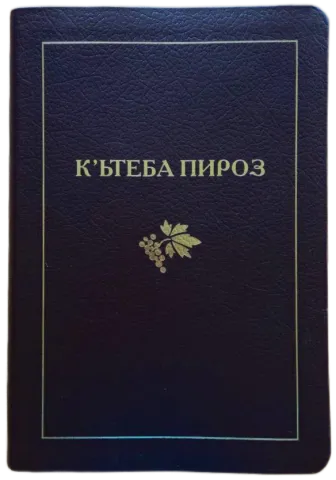
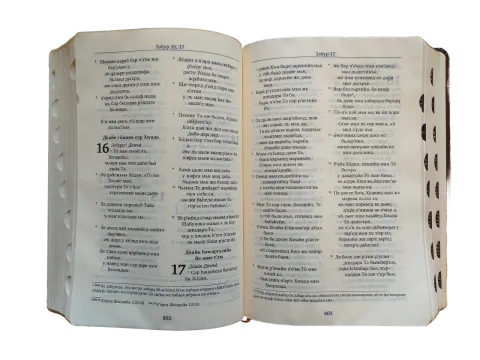
The herculean effort to translate the Holy Scriptures into the Kurmanji variant of the Kurdish language spoken in the Caucasus region has finally been completed after many years of work: the Institute for Bible Translation has published the first complete Bible in the Transcaucasian dialect of Kurmanji Kurdish using the Cyrillic script.
The Kurds are an ancient people residing primarily in the historical and ethnographic region of Kurdistan, which is presently divided between Turkey, Iran, Iraq, and Syria. Their global population is approximately 40 million. According to the 2021 Russian census, there are 50,701 Kurds in the Russian Federation, primarily in Moscow, the Krasnodar and Stavropol regions, the Republic of Adygea, and the areas around Moscow, Nizhny Novgorod, Novosibirsk, Tambov, Saratov, Sverdlovsk, and Yaroslavl.
The Kurdish macrolanguage belongs to the Iranian language family and includes several major dialects. The majority of Kurds (62%) speak the Northern Kurdish variant of Kurmanji. The Caucasian dialect of Kurmanji is widespread in Armenia, Georgia and Russia. Traditionally, Kurds used the Arabic script, but in the 20th century, the Roman/Latin and Cyrillic scripts also became widespread, the latter in countries of the former USSR. The present edition of the Kurmanji Bible has been prepared in Cyrillic, with a Roman-script version planned for release soon.
The history of translating biblical texts into Kurdish spans several centuries. The first known attempts date back to the early 19th century: one of the earliest translations of the Gospel was completed by the Chaldean Catholic Bishop Shevriz, but remained unpublished. In 1830, the Armenian preacher Stephan translated the Gospel into Kurmanji, and in 1865, the British and Foreign Bible Society published the Gospel of Matthew in the Armenian alphabet—the first book published in the Kurdish language. From the late 19th century on, Armenian and European missionaries were actively engaged in translation work. Translations of Scripture portions were produced into various Kurdish dialects using different scripts—Armenian, Arabic, Roman/Latin, and Cyrillic.
The history of this particular translation of the Bible into Kurmanji Kurdish began in the early 1980s in Armenia. Nadr Ozmanyan, who was educated in Soviet Armenia, was inspired by an Armenian-Kurdish edition of the Gospel of Matthew that came into his possession. Initially, Nadr attempted to adapt the 19th century text to make it understandable to modern Kurdish readers, jotting down handwritten drafts in a small notebook he always carried with him. One day, he met a representative of the Institute for Bible Translation and handed him one of the translated pages to inquire whether a translation in this dialect already existed. The answer was negative—and Nadr was encouraged to continue his work.
Thus, in the early 1990s, the Institute for Bible Translation embarked on a Kurdish translation project, forming an international team of biblical and Kurdish language specialists who worked for over three decades to produce a Bible text understandable to Kurds in the Caucasus. In 1993, the Gospel of Matthew was published in Kurmanji. This was followed by translations of the Gospel of Luke and the Acts of the Apostles. The complete New Testament was published in 2000. In 2009, the Old Testament books of Ruth, Esther, and Jonah were published. In 2010, two versions of the Pentateuch were released, one in Cyrillic and the other in Roman script. In 2016, the Psalms and Proverbs were published in both scripts.
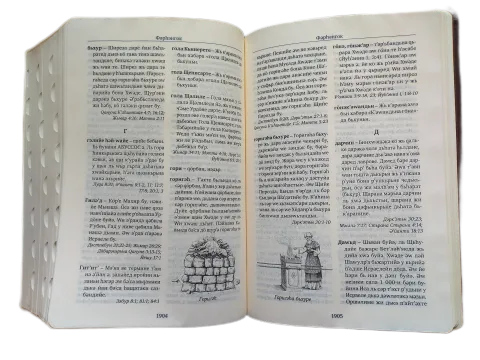
This edition of the complete, canonical Bible is supplemented with additional materials for in-depth study of the biblical text. A detailed dictionary with illustrations will help readers understand difficult terms. The appendix includes tables of ancient weights and measures and their modern equivalents in the metric system. It also features photographs of ancient biblical codices and manuscripts, colorful maps of the Ancient Near East, the routes of the Apostle Paul’s journeys, and diagrams of the structure of the Temple in Jerusalem.
The electronic version of this edition can be accessed on IBT’s website.