
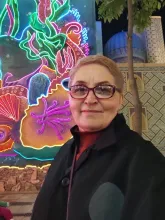
IBT recently held a training seminar in Uzbekistan on translating the Old Testament book of Proverbs into the Turkic languages. Here is what Balkar translator Marziyat reported about this seminar: “Once I heard a lecture on love by Fr. Alexander Menn, who said that when Christ came, it wasn’t as if the world was completely unprepared – the history of humanity given in the Old Testament had actually prepared people for His coming. The Wisdom literature, and Solomon’s Proverbs in particular, were part of this preparation for the Jewish people. But what about for the rest of humankind? The seminar on Proverbs offered us a vivid answer to this question. All of the translation teams came to the seminar with collected proverbs and sayings from our own peoples that echoed Solomon’s Proverbs. Exchanging our findings with each other turned out to be simply amazing: someone would begin to quote a proverb of their people, and a participant from another group would pick up on it and finish the saying! It turned out that so much of what we find in biblical Proverbs is already in our folk wisdom. We did not expect this!”
I asked Marziyat if there was anything fundamentally different in the biblical text that can’t be found in Balkar folk wisdom.
“We came to the conclusion that the life and thinking of the Jewish people are very close to the Turkic worldview. For example, in Proverbs, a person is considered an integral part of a community. What is important is the home, the family, and ultimately the people. This is not a philosophy of individualism. It’s exactly the same with the Turkic peoples. In all our proverbs it is said that if you break away from your people and family, you will perish. The mental space that we find in the Bible is very close to the Turkic world. This was surprising for us, because the Bible is the book of a special people, through whom God knocks on the door of all of humanity. The Jews are His chosen people, so it’s all the more striking that their own system of mental and spiritual coordinates fits so well with others. Millions of people can understand and accept this coordinate system, because we have kinship with it on a deep level.
In the Russian language, Solomon's proverbs have long become catchphrases. They live in the language, and many people quote them without even suspecting that they are quoting the Bible. Our task at this seminar was not only to translate the meaning, but to translate the qualities of the original proverb forms: not to flatten or primitivize the biblical text, but to try to preserve its poetry and musicality. We aspired to translate biblical aphorisms to be easy to say while at the same time preserving their internal rhythm. Only then will there be a chance of having this translation, or at least some part of it, be accepted and used by our people.”
I then asked Marziyat whether this new perspective on Proverbs gives anything to the Balkar project, since the book of Proverbs was already translated into their language years ago. What are her thoughts about that old translation in light of her new knowledge gained at the seminar? Is the Balkar team planning to re-translate the book or somehow revise the existing translation?
“The book of Proverbs was translated into Balkar by our first Bible translator, Ibrahim Gelyastanov. This man made such a huge impression on me. He really knew our mother tongue and he truly believed in the Scriptures he translated. In my 60 years on earth, Ibrahim was the only person who caused me to be at a loss for words when I first met him. I even forgot to have lunch that day! He was the first Balkar to believe in Christ. In his translation of Scripture, Ibrahim tried to be extremely accurate in conveying the meaning … but sometimes he was far from conveying the internal music of the text. We discussed this in our team and will try to make changes in the Balkar form, while preserving most of the words that he found fitting to express these truths.”
So, I wondered aloud, does your new approach mean that for the sake of poetic beauty, you will feel free to substitute actual Balkar folk proverbs for some of the biblical verses that they’re similar to?
“We’ve discussed this as well,” Marziyat responded quickly. “This is a very delicate point. We are in no way going to compromise our Bible translation by over-adjusting it to match folk proverbs. We should not end up with ‘Balkar proverbs of Solomon’, ‘Kyrgyz proverbs of Solomon’, etc. We can make careful use of the folklore developed by our peoples over the centuries, and at the same time remain faithful to the biblical text. It’s like a balancing act walking a very thin rope between two extremes.”
Marziyat’s words could be taken to mean that the wisdom collected in the book of Proverbs is already more or less present in Balkar folklore (and maybe in the folklore of all Turkic languages). According to this point of view, the book of Proverbs doesn’t really teach anything new but merely pleases the heart with a nice correspondence between the native and the Biblical and allows one to feel that Hebrew Scripture is close to one’s own cultural traditions.

This vision was clarified by another seminar participant, an Altai translator named Synaru, who made the following important distinction: “I wouldn’t say that the wise sayings of the Altai people correspond literally to the aphorisms found in Proverbs. The sayings of Scripture point directly to God as the source of wisdom, and this is how they differ from folk proverbs. Thanks to the biblical Proverbs, we can understand whom we should turn to in order to become truly wise.
It’s already our task as translators to make the biblical Proverbs sound natural in our own culture. The past seminar provided us with the needed tools to accomplish this. One of our assignments was to find sayings in Proverbs that could be translated into our mother tongue using the same oral techniques as found in our folk genres. We decided that for the Altai language, the most suitable genres for translating Proverbs were ‘instructive sayings’ (ukaa sostör) and ‘proverbial sayings’ (kep sostör). Both of these have a rhymed form and make use of various poetic devices. We will apply these Altai literary forms to revise the already translated book of Proverbs. In light of the fact that the Bible is the Word of God, it will be necessary to add to our translation those meanings and words that are not found in our folklore.
Here is a small example. There is an Altai folk saying that goes: ‘With white (pure) thoughts one is blessed; with black thoughts one is cursed’. We compared this with Proverbs 3:33: ‘The Lord’s curse is on the house of the wicked, but he blesses the home of the righteous’ (NIV).
In our rendering of this verse, we kept in mind the techniques of rhythm, rhyme, alliteration, assonance, and word repetition that are characteristic of Altai folk sayings, and applied these techniques where possible to our translation of 3:33. All of these poetic devices are needed to make it easier for someone to easily remember these proverbs. If we want to inspire Altai readers to be guided in life by biblical wisdom, we should make the translation of these proverbs short, clear, and rhythmic. Then they will enter readers’ hearts. There is no other way to remember them.”
We would greatly appreciate your financial assistance towards IBT projects. You can find IBT's bank info in Russia below. If you prefer to send your donation through a forwarding agent in the U.S. or Europe, please write to us and we'll provide the details of how this can be done.
IBT Russia/CIS is a non-profit organization financed through contributions from individuals, sponsoring organizations and foundations.
You can donate to IBT:
Through: AO UniCredit Bank, Moscow
SWIFT: IMBKRUMM
In favour of: Institute for Bible Translation
Address: 119334, Russia, Moscow, Andreevskaya nab. 2
TIN (INN) 7736231521
9-digit Bank identification code in Russian banking system: 044525545
Account no. (IBAN):
634261 USD 4020 02 001 or 40703840700010142881
634261 EUR 4020 02 001 or 40703978700010366720
634261 GBP 4020 02 001 or 40703826600010366723
Through: NOSTRO ACCOUNTS OF AO UNICREDIT BANK, MOSCOW:
USD JPMORGAN CHASE BANK N.A., NEW YORK SWIFT CODE: CHASUS33
EUR UNICREDIT BANK AG (HYPOVEREINSBANK) , MUNICH SWIFT CODE: HYVEDEMM
EUR UNICREDIT BANK AUSTRIA AG, VIENNA SWIFT CODE: BKAUATWW
EUR UNICREDIT S.P.A., MILANO SWIFT CODE: UNCRITMM
GBP THE ROYAL BANK OF SCOTLAND PLC, LONDON SWIFT CODE: RBOSGB2L
Important! In the field "designation" write "CHARITY DONATION"
For more information address IBT
You may sign up to receive our Russia/CIS English newsletter here