
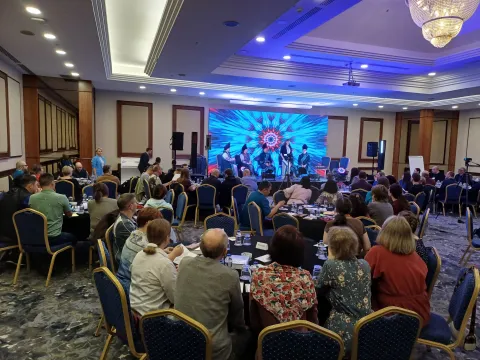
On March 17-23 IBT held a seminar devoted to Scripture Engagement and Ethnoarts, with the participation of several partner organizations. The main idea of the event was to give translation teams and church leaders a better understanding of contemporary methodologies for making translated Bible texts more available and interesting for people in their language community. Representatives of 33 IBT translation projects, as well as several partner projects, took part in the conference.
Besides being a training event, the seminar became a venue for experience sharing between talented experts in the folk arts from many different minority ethnic groups. The training itself was based on an analysis of 8 important conditions for successful Scripture Engagement:
1. Using an appropriate level of language in the Scripture translation
2. Translating in a fitting fashion for the sociocultural setting (stylistic issues, doctrinal accuracy, appropriate key term renderings, the external appearance of printed materials, etc.)
3. Getting Scripture into accessible forms (paying attention to the literacy rate and orality in the culture; using video and audio technologies; implementing local art forms)
4. Understanding the background knowledge of potential users (ensuring that Scripture is comprehensible to ordinary people, determining whether the historical and cultural backgrounds of the biblical narrative are known to the local audience)
5. Promoting availability (helping members of the society to know about the Bible translation project and easily obtain Scripture products)
6. Analyzing the level of spiritual hunger and felt needs (obtaining a clear picture of people’s real needs, analyzing their biggest problems, fears, traumas, guilt or shame types of cultures, life cycle rituals, beliefs and practices, and how Scripture can fulfil these felt needs)
7. Seeing the obstacles to Scripture use in the society (if the people’s cultural identity is associated with a non-Christian religious tradition, there may be obstacles to distributing Bible materials)
8. Engaging in partnership (improving relations between the Bible translation team and local churches and gatherings of believers, if any exist).
The seminar participants gathered in groups according to the linguistic and geographical area where they live (for example, Siberia or Dagestan) to discuss each of these points, paying special attention to how the conditions are met in their specific sociocultural circumstances. Typically, IBT translation teams discuss some of the same issues when planning their translation project. Nevertheless, being together at a conference devoted to these issues together with other translation teams provided an excellent intercultural platform for broader discussion and brain-storming, leading to new ideas. This was probably the main fruit of the Seminar: a fountain of new ideas born as a result of sharing.
Each day began with a different ethnocultural presentation. For example, we heard an Avar song, watched a Karachay shadow theatre on the story of Jonah, and listened to music by an Altai Christian band. One of the lecturers even shared songs and vocal techniques used by distant cultures in Africa. Most participants brought their ethnic costumes and musical instruments. Many prepared a presentation about their culture accompanied by video materials. On the final evening, there was a lively intercultural concert. We heard the Lord’s Prayer in Balkar sung by a Balkar pastor and a Khakas Psalm sung by a choir member of an Orthodox church. We followed a Karachay wedding ceremony with interest, danced as a large group to music played by the Altai band, and discovered the beautiful dances of several Finno-Ugric peoples. There were numerous songs from the Yakut, Even, Evenki, Chukchi, Buryat, Khakas, Tuvan, Tajik and Uzbek teams, representing both folk and Christian traditions. The Lezgi and Kabardian teams showed us their world-famous Caucasian dances.
Here are several reviews of the event from seminar participants:
The Tuvans and Maris added a lot to the list of artistic genres – congratulations! We can’t wait for the next conference, called Arts Serving a Better Future.
Thank you so much from the Komi team for the seminar, for meeting old friends and finding new ones...
Tremendous gratitude from the Republic of Buryatia to all the organizers of this wonderful and relevant seminar, for new acquaintances! God’s blessings to all of you, dear friends!!!
A huge heartfelt ‘thank you’ from the Yakut group for a very useful seminar, meetings with good friends and wonderful days! May the knowledge acquired here become our new wings to fly on.
A big ‘thank you’ to the organizers from the Even and Evenki groups. We received a lot of useful information and spiritual reinforcement!
I got answers to many questions… The Altais will remember this event.
Glory to God and tremendous gratitude from the Avars! The organizers and helpers conducted the seminar harmoniously and magnificently. Thanks for the wonderful meetings, communication and new acquaintances. May all this serve the glory of God and bring forth good fruit and great results!
Despite centuries of Christian tradition, the first complete New Testament in the Ossetic language lay in the British Library for more than 60 years without use (during the Soviet era), and the first catechism of 1798 with texts from the Bible lay unknown for more than 200 years in the warehouse. I call these ‘mummified’ translations. Therefore, the topic of the workshop, the accessibility of the Bible, was very important for us. The Ossetic team was deeply impressed by the scope of the seminar and especially by so many talented, well-educated and sincere believers from different ethnic groups.
I have long dreamed of someday seeing the understanding and value of the arts for the peoples of Siberia. I saw this last week and for me this was a dream come true!
Dear brothers and sisters, looking at your sacrifice and your desire to reach the people through culture, art, etc., we have a desire to imitate you and work even harder for our people. May God bless each of us in this endeavor. In Chuvashia there is still snow on the ground, but we hope that the warmth and light coming from our hearts will melt the snow of parting and the long-awaited spring will come.
The conference was a fabulous, forward-thinking event that puts IBT and SIL streets ahead of other Bible Translation organizations. I believe this training has forever changed the way the participants think about the role of Scripture Engagement and Ethnoarts in what they do as translators. Thank you SO much for putting on this event!
We would greatly appreciate your financial assistance towards IBT projects. You can find IBT's bank info in Russia below. If you prefer to send your donation through a forwarding agent in the U.S. or Europe, please write to us and we'll provide the details of how this can be done.
IBT Russia/CIS is a non-profit organization financed through contributions from individuals, sponsoring organizations and foundations.
You can donate to IBT:
Through: AO UniCredit Bank, Moscow
SWIFT: IMBKRUMM
In favour of: Institute for Bible Translation
Address: 119334, Russia, Moscow, Andreevskaya nab. 2
TIN (INN) 7736231521
9-digit Bank identification code in Russian banking system: 044525545
Account no. (IBAN):
634261 USD 4020 02 001 or 40703840700010142881
634261 EUR 4020 02 001 or 40703978700010366720
634261 GBP 4020 02 001 or 40703826600010366723
Through: NOSTRO ACCOUNTS OF AO UNICREDIT BANK, MOSCOW:
USD JPMORGAN CHASE BANK N.A., NEW YORK SWIFT CODE: CHASUS33
EUR UNICREDIT BANK AG (HYPOVEREINSBANK) , MUNICH SWIFT CODE: HYVEDEMM
EUR UNICREDIT BANK AUSTRIA AG, VIENNA SWIFT CODE: BKAUATWW
EUR UNICREDIT S.P.A., MILANO SWIFT CODE: UNCRITMM
GBP THE ROYAL BANK OF SCOTLAND PLC, LONDON SWIFT CODE: RBOSGB2L
Important! In the field "designation" write "CHARITY DONATION"
For more information address IBT
You may sign up to receive our Russia/CIS English newsletter here