

Olga is an Evangelical Christian from the newly formed Yakut Scripture Engagement (SE) team. Since the first seminar on Scripture Engagement in Turkey in March 2024, she has been engaged in this completely new kind of IBT activity with great inspiration and inexhaustible imagination, perhaps greater than in any other IBT project. “I want to share my personal experience,” Olga started her story at another SE seminar, this time in Moscow. “Our family are Yakut bilinguals. We speak Yakut and Russian equally well. When I was a little girl, my mother was completely Russian-speaking, and only then did she learn the Yakut language. At first I attended a Russian-speaking church. I would come to the worship service, sit down on the church bench, listen, and nothing would touch me, and I would leave, and this repeated over and over again. Dad was a pastor, and had translated the Epistle to the Hebrews into Yakut together with IBT’s translator Sargylana. And then my mom had a stroke, and we had to move to Yakutsk for her treatment. A Yakut church group was organized there. I remember how once we were sitting in the church, and some words in the Yakut language were displayed on the screen. And I remember this moment very clearly: these Yakut words went straight to my heart, not to my eyes and not to my brain. I thought: ‘Wow! How interesting: I always thought I was thinking in Russian!’ And since then, God has been leading me in such an amazing way that I am falling in love with my native language more and more every day.”
“In spring of 2024 IBT invited us to a SE seminar in Antalya. We gladly agreed, but had very little idea of where we were going and why. And so, from the very first day of the seminar we were bombarded with a barrage of information. We can say in the words of the Apostle Paul that before the seminar we saw our ministry like ‘in a mirror indistinctly’, but after the seminar we suddenly began to see it clearly. We began to understand ourselves. We realized that when we followed Christ, we had dismissed our native culture as something of little importance, irrelevant to the newness of the New Testament. We loved God as if for ourselves alone, not thinking that every member of our people needs salvation. But we are Sakha people ourselves. So who better to tell a person from the Sakha people about Christ than another Sakha person? And we realized what exactly we should do to achieve this purpose.”
“We returned home encouraged, with burning hearts, and were able to ignite the hearts of other members of our church, including the pastors. We started by sending pictures with Bible passages through messenger apps. And here’s what happened. A girl from our team started posting pictures with Bible quotes on Instagram. And her relative immediately criticized her: ‘Why are you posting Bible verses? You’re a Yakut. You have your own faith. Why are you studying the Bible?’ And then it happened that one of her pictures with a Bible quotation was published without a link. And what do you think? The response was from none other than this same relative, ‘Wow, what clever words you’ve found!’ And then we realized that many Sakha people have an artificial, cultural barrier to their perception of the Bible. They think this is a “Jewish God” or a “Russian God,” but not a “Yakut God”. After this realization, we started sending biblical quotes without references to the Bible, and people started joining our channels. The most important thing for us is that people read God’s Word. We believe that His Word is alive and effective, and it begins to work in their hearts. The Sakha people read wise sayings and take them to heart. Time will pass and people will eventually recognize that these words are from the Bible. This is the strategy we have developed. We are in no hurry. We have a long-term project, and if explicit mention of the Bible repels people, we will not reveal all our cards to them at once. Let people first accept God’s enlightening wisdom. Let them be imbued with it.”
One might think that special efforts to communicate the Scriptures should be made only to those Yakuts who are far from Christianity and the Bible. But it soon became clear that Bible reading in churches was not something to be taken for granted. Wit and imagination were also needed to motivate this, and they bore precious fruit. Here is Olga’s next story:
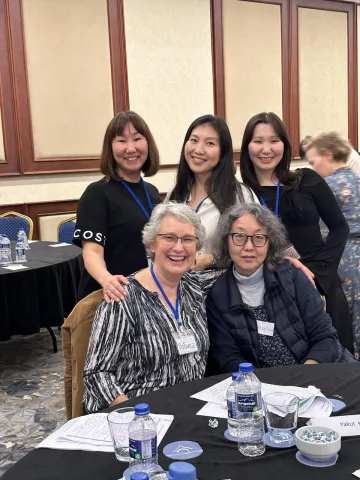
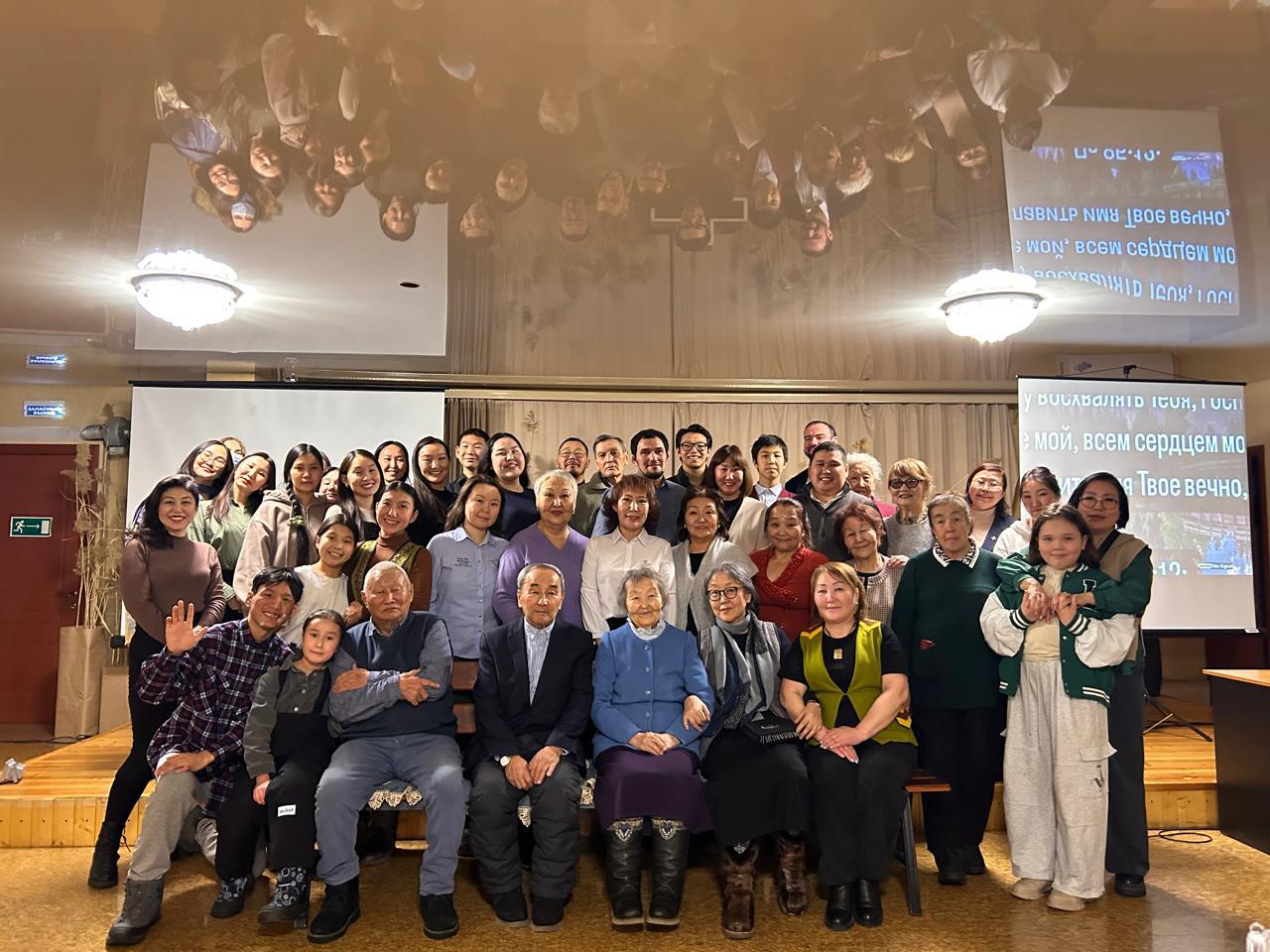
“There is a person in our Yakut project, whom we all love and respect very much. This is Sargylana Leontieva, translator, exegete and translation project coordinator, who has devoted her whole life to translating the Bible into the Sakha language. But who do the translators work for? They translate for their readers. Readers get the result, the book, but they have no idea how this book came into being, how many difficulties there were, how much money was needed to finance the project, and who was involved. So we decided to highlight this issue. We invited all Yakut-speaking people from our church association. A new edition containing Genesis and Exodus in Yakut came out, and we announced a meeting in the church called ‘About the Word around the table.’ We called our event a ‘marathon through the book of Genesis.’ We told people, ‘We are giving you time to read the book. There will be a meeting at the church on this date with a quiz, gifts, and a tea party.’ And the people came. One sister in the Lord had started preparing for this marathon a month and a half in advance, and every evening people had been gathering together to read a chapter from Genesis, and then each of them wrote down their impressions and reviews. All this was done from the heart. People marveled at the translation, they took in the meaning, and they understood so much! And most importantly, they enjoyed reading it. And now they are looking forward to the next marathon Scripture reading session. Four team members including Sargylana attended the announced organized meeting, and they finally met their target audience face to face, and their target audience saw one of the translators whose labor provided the opportunity to read Scripture in Sakha. It was a very heartwarming meeting. The young people were inspired and now they want to continue reading in their own language.”
In early 2025, an avalanche of letters from both Orthodox and Evangelical Yakut believers came to IBT with requests to reprint the Psalter in the Yakut language and with reviews of the books from the Bible already translated into Yakut. We would like to quote an excerpt from one letter: “Hello, I am 34 years old. My husband and I have been members of the Olokh Suola (Way of Life) church in Yakutsk for 10 years. In our church all services are held in our native Yakut language, and we thank God that we have the opportunity to read the Word of God, pray, listen to sermons and sing praise songs in our mother tongue! It is a great privilege and a great joy for all of us. My husband and I have four children and we are very happy that our favorite book, “Bible Stories”, has been translated into the Yakut language. In Yakutia we are currently actively promoting the preservation of our language and culture, and people, for the most part, treat Christianity as the faith of the Russian people and often react negatively to invitations to come to church. But when we give Bibles and Christian literature in the Yakut language, people accept them gladly. Not all members of our church understand the Russian Synodal translation of the Bible, not to mention non-believers, but we read the Bible in the Yakut language with enthusiasm, as the translation is very clear, and for each people group their mother tongue is anyway closer than any other language. We are looking forward to book after book, and we hope and believe that soon we will be able to read the whole Bible in our native language.”
We would greatly appreciate your financial assistance towards IBT projects. You can find IBT's bank info in Russia below. If you prefer to send your donation through a forwarding agent in the U.S. or Europe, please write to us and we'll provide the details of how this can be done.
IBT Russia/CIS is a non-profit organization financed through contributions from individuals, sponsoring organizations and foundations.
You can donate to IBT:
Through: AO UniCredit Bank, Moscow
SWIFT: IMBKRUMM
In favour of: Institute for Bible Translation
Address: 119334, Russia, Moscow, Andreevskaya nab. 2
TIN (INN) 7736231521
9-digit Bank identification code in Russian banking system: 044525545
Account no. (IBAN):
634261 USD 4020 02 001 or 40703840700010142881
634261 EUR 4020 02 001 or 40703978700010366720
634261 GBP 4020 02 001 or 40703826600010366723
Through: NOSTRO ACCOUNTS OF AO UNICREDIT BANK, MOSCOW:
USD JPMORGAN CHASE BANK N.A., NEW YORK SWIFT CODE: CHASUS33
EUR UNICREDIT BANK AG (HYPOVEREINSBANK) , MUNICH SWIFT CODE: HYVEDEMM
EUR UNICREDIT BANK AUSTRIA AG, VIENNA SWIFT CODE: BKAUATWW
EUR UNICREDIT S.P.A., MILANO SWIFT CODE: UNCRITMM
GBP THE ROYAL BANK OF SCOTLAND PLC, LONDON SWIFT CODE: RBOSGB2L
Important! In the field "designation" write "CHARITY DONATION"
For more information address IBT
You may sign up to receive our Russia/CIS English newsletter here