
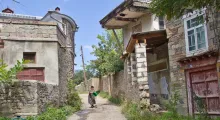
“Every Dagestanian man has a duty to maintain his father’s house and not let it fall into disrepair. This is why I go back every year to the Lak town of Kumukh, where I was born and raised. One day I was walking through the park in Kumukh and heard someone calling me. I turned around and looked: a young woman was approaching with a little girl in her arms and a boy running after her. The boy turned out to be my namesake, and the young mother was calling him, not me. I heard the child talking to his mom in pure Russian, and she was talking to him in Russian with a pronounced Lak accent. I listened for a while and then said to her: “It’s of course great that your child knows Russian, but he would have learned it in any case. Who, apart from you, will speak to him in his mother tongue? At least for the sake of preserving the language.” Her answer just about killed me: “Who in the world needs the Lak language? I’d rather teach my son Arabic.”
This is the sad story that Aslan Magomedov, the director of the Lak Music and Drama Theater in Makhachkala, related to me while in Moscow to help record the Lak translation of Luke’s Gospel. After a busy day of work, Aslan agreed to talk with me about the current state of his native language, as well as about his work and participation in IBT’s Lak project.
“When I was a boy, the Lak language reigned supreme in our home,” Aslan recalls. “Both my father and mother worked in the theater. My father is an Honored Artist of Russia, my mother is an Honored Culture Worker of the Republic of Dagestan. My father always told me: “You can learn the Russian language and the languages of Dagestan’s other ethnic groups on the street, and you will of course be learning Russian at school.” In the course of my life, I have been constantly convinced of the truth of his words. Until 1968, when I went to 1st grade, we lived in a Lak-speaking village. In Soviet times, our native language was taught in rural elementary schools. But when it was time for me to start school, the theater where my parents worked was unexpectedly moved to the city. In city schools, all education was conducted in Russian, and I did not know it at all. Imagine the situation: a child is about to start first grade in three months and needs to learn a new language from scratch in those three months so as to be able to understand the teacher. Thus, when I moved to the city, my dad sent me to play with other boys on the street so that I could learn Russian from them. He only let me come home to eat. Plus, he hired a tutor to speak Russian with me. By the time school started, I could already understand Russian
decently.
As an eight-year-old boy, I spent a month in the town of Buynaksk, where in Soviet times most communication was in Kumyk. The Russian language was of course understood there too, but at the same time there wasn’t a single person (be they Avar, Dargi, Lezgi or Lak) who did not also know the Kumyk language. So I began to understand Kumyk too after a few days of playing out on the street. Then I studied at a university in Tbilisi (the capital of Georgia). The other guys there knew Russian perfectly well and communicated with me in Russian, so at first I couldn’t understand why they would immediately switch to Georgian and forget about my presence whenever another Georgian would approach. I asked them about this, and they replied with humor: “You live here now, don’t you? So learn our language!” In the end I began to learn and understand Georgian as well. I realized that they were doing the right thing in preserving their language and culture.
The Lak theater is considered one of the best in the North Caucasus, and a lot of tourists visit it nowadays. For the last ten years, we have been purposefully taking classical works and performing them in both Russian and Lak to reach children, students, and young people. That is, we prepare the same performance in two versions. We also perform Lak plays in our native Lak language, but with simultaneous translation into Russian through headphones. When I’m not busy performing in a play myself, I like sitting among the audience and watching the audience. One day I noticed a few girls who came to the same performances not once but several times. I decided to talk to them, and they told me that they purposefully come to learn their native language by first hearing the Lak, then the Russian translation. They knew Shakespeare’s “The Taming of the Shrew” very well and listened to the Lak performance. During the fourth or fifth performance, they no longer needed the Russian translation and took off their headphones.”
I asked Aslan how he got acquainted with the Institute for Bible Translation and why he agreed to help out as a reader for our Lak audio recording projects. Aslan first explained that he has a burning desire to do anything and everything possible to preserve his language. He went on: “It all started about ten years ago, when a recording team came from Canada to do the Lak audio for the ‘Jesus’ film. The script had been translated by the now deceased Kazbek Mazaev, who was an incredible translator and expert in our language. Through him, the Canadian team began to look for actors to voice this film. They searched for a long time for someone who could voice Jesus, and they settled on me. It turned out that they had first asked Kazbek what I was like in terms of my personal life, whether I drank or not, and so on, since whoever voiced Jesus needed to be above moral reproach. So I voiced Jesus, and then we went on to do an interesting song project. The lyrics of the songs were taken from biblical texts, also in Mazaev’s translation, but were set to Lak folk melodies. CDs with these songs were sold out immediately, and it soon became impossible to find them. And the “Jesus” film was distributed on video cassettes. I had three of these at home, and all three disappeared. Quietly, but gone forever,” Aslan laughed. “People assured me ‘We’ll return the video, don’t worry,’ but none of them ever returned anything. After I voiced the role of Jesus, IBT learned about me and contacted me.”
I was interested in hearing what Aslan personally gained from his acquaintance with the Gospel text, and he answered as follows: “I began to discover from a practical Muslim point of view that mullahs say a lot of similar things, only they change the names to those accepted in Islam: Jesus is Isa, Solomon is Suleiman, and so forth. And plot-wise, everything fits together.” When I heard that Aslan called himself a Muslim, I asked how deeply he knew the Koran. “I’m not very familiar with the Koran,” he responded. “I began to compare the stories I had heard from my father, as well as the book about Islam that I recently found in his possession, with the stories I had read during the Gospel audio recording, and there were many similarities. It’s not for nothing that they say that God is one. It’s true. Islam is currently being actively promoted across the Caucasus region; Islamic universities are being opened, and there’s an Islamic humanitarian university in Makhachkala. And I think it wouldn’t be at all bad for both Islam and Christianity to be taught at school, at least as an elective, so that children could compare both. Not all children would later go to the mosque or to church, but at least they could hear God’s Commandments at school. I’m convinced that if these were taught, children would be molded in a very different way by their school education. Unfortunately, religion nowadays sometimes becomes a thing of fashion – for example, when a Muslim man grows out his beard and is outwardly observant, but his actions do not correspond to his pious appearance. This is terrible.”
My last question concerned the relevance of the Lak translation of the Gospels for modern Laks: “Will these texts be read if, as you say, people are losing their language?”
“Well, reading is difficult, but listening is easier. That’s why we audio record these texts,” Aslan summed up. “You remember the biblical songs that had been set to Lak folk melodies and sold out immediately? Understanding the language is accelerated when a person listens to it spoken. And if people don’t know their language well, they won’t be able to read. The translations that have been produced will merely stay unused on their shelves. Distributing them in the form of videos, audio recordings and apps with the possibility of hearing the texts read aloud will be the most effective method.”
We would greatly appreciate your financial assistance towards IBT projects. You can find IBT's bank info in Russia below. If you prefer to send your donation through a forwarding agent in the U.S. or Europe, please write to us and we'll provide the details of how this can be done.
IBT Russia/CIS is a non-profit organization financed through contributions from individuals, sponsoring organizations and foundations.
You can donate to IBT:
Through: AO UniCredit Bank, Moscow
SWIFT: IMBKRUMM
In favour of: Institute for Bible Translation
Address: 119334, Russia, Moscow, Andreevskaya nab. 2
TIN (INN) 7736231521
9-digit Bank identification code in Russian banking system: 044525545
Account no. (IBAN):
634261 USD 4020 02 001 or 40703840700010142881
634261 EUR 4020 02 001 or 40703978700010366720
634261 GBP 4020 02 001 or 40703826600010366723
Through: NOSTRO ACCOUNTS OF AO UNICREDIT BANK, MOSCOW:
USD JPMORGAN CHASE BANK N.A., NEW YORK SWIFT CODE: CHASUS33
EUR UNICREDIT BANK AG (HYPOVEREINSBANK) , MUNICH SWIFT CODE: HYVEDEMM
EUR UNICREDIT BANK AUSTRIA AG, VIENNA SWIFT CODE: BKAUATWW
EUR UNICREDIT S.P.A., MILANO SWIFT CODE: UNCRITMM
GBP THE ROYAL BANK OF SCOTLAND PLC, LONDON SWIFT CODE: RBOSGB2L
Important! In the field "designation" write "CHARITY DONATION"
For more information address IBT
You may sign up to receive our Russia/CIS English newsletter here