

“Buryat culture has two main colours in our tradition,” said IBT’s Buryat translator Darima, whom I interviewed on the eve of the publication of the full Bible in the Buryat language. “These are turquoise-blue, the colour of the turquoise stone, and red, the colour of coral. This is true even about clothes: turquoise and coral-coloured clothes suit me best. When the Buryats adopted Buddhism, the orange/saffron colour also appeared in our culture. Red is the colour of internal revolution, the transformation of the mind. As for turquoise, this is the colour of the blue sky and our blue Lake Baikal. All of our traditional costumes are turquoise-blue. Today, the IBT publishing department and I were discussing what colour the Buryat Bible should be. Everyone, including me, was in favour of turquoise.”
The Buryat project was one of IBT’s earliest projects, and was already well underway by the time Darima joined the translation team in 1996, first as a philological editor and then as a translator.
“Our translator at that time was Professor Sergey (Tsyrendashi) Badmaevich Budaev. He was a very well-known Buryat translator with his own translation methodology, and in Soviet times it was he who was entrusted with translating all the volumes of Lenin and Stalin,” Darima recalls. “He told me interesting things about translating the texts of Marxism and Leninism: the translation had to be completely literal, word for word, you could not deviate from the source text in the slightest. Now, I graduated from the Department of Literary Translation at the Moscow Institute of Literature, where we studied translation theory, and I had an understanding that translation should be primarily meaning-based, not literal. The background experience of each Bible translator determines a great deal. I remember Prof. Budaev telling me: ‘If we had allowed ourselves such liberty in translations as you do, we would have been immediately put in prison or even shot.’”
“The Bible is not fiction, it has its own specific characteristics, and our translation team had to find a balance: to make the translation both meaning-based and accurate at the same time, without any fancy stuff. When we began our translation work, IBT, SIL, and BSR (Bible Society of Russia) were conducting plenty of seminars for translators and editors, where we analyzed numerous examples of Scripture texts and received guidance from experienced Bible translation consultants. When we encountered unfamiliar concepts from the source culture, our translation could be descriptive, or we could use borrowings, but we always tried to keep the borrowings down to a minimum. Instead we tried to find equivalents in the Buryat language. Sometimes it may seem that our translation uses some concepts from Buddhism or shamanism, but, in fact, when you think about it, these concepts are actually common throughout Buryat culture and it’s impossible to label them as belonging to one particular religious tradition. We can’t say, ‘This is a Buddhist word’ just because Buddhists use it; these words were used even before the Buryats encountered Buddhism.”
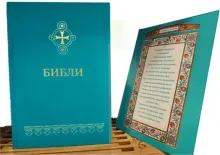
The full Buryat Bible came about as a result of many years of work by two translation teams from two partner organizations: the Bible Society of Russia translated the Old Testament, while IBT translated the New Testament. Over the past 7 or 8 years, the teams have been merging the texts, looking for compromise solutions to difficult problems. I asked Darima what kind of work she had to do in order to combine the two Testaments into a single edition, and what was most difficult in the process.
“Even before the merger project began, I had been involved in the BSR Old Testament project as a stylistic editor. I must pay tribute to the Old Testament translation team: they are highly professional translators. Irina Gomboin knows Biblical Hebrew and she had been translating the OT directly from the original language. While I was learning New Testament Greek at an Orthodox university in Moscow (it was an unforgettably interesting time), she was taking courses in Ancient Hebrew in the Netherlands. Both of our teams had very good exegetical advisors. When the joint project started, we didn’t always agree with each other at first, but we did have some common ground that enabled us to eventually come to a consensus. The Buryat churches helped us out a lot in field testing. If we had competing Buryat terms that we could use, we usually chose the one that people better understood during field testing. When we were translating the New Testament, we wanted to make sure that as many people as possible understood the text, while at the same time we tried our best not to impoverish our language. As for the Old Testament translation, you can see from the text that the translators use a very beautiful literary language with rich vocabulary that is sometimes not easy for everyone to understand: some words need to be explained to the readers, but there is a glossary for that.”
“What was most difficult to decide on was whether to address God in the singular or in the polite plural. Like in Russian or German, the Buryat language also sometimes uses a 2nd person plural pronoun for addressing a singular person politely. But the usage of this plural pronoun of respect differs in various regions of Buryatia. In some districts, one’s mother or father is always addressed in the respectful plural form. You can’t address them otherwise, it would be unacceptably rude. As for me personally, I grew up in a region where it’s normal to address your mum, dad, or grandmother with a singular pronoun. That’s why I was in favour of also addressing God in the singular, since He is close to us, He is our Father. I transferred my understanding from ordinary life to the Bible. As for the first NT translator, Prof. Budaev, he was in favour of strictly literal translation. Since the Russian Synodal Bible always addresses God with a singular pronoun, there was no other possible option in his eyes.
Thus we found ourselves in a situation where God was addressed with a polite plural in the Old Testament but with the familiar singular in the New Testament. We began to think about how to unify these pronouns. At first it seemed easier to use the singular pronoun throughout the entire Bible, especially since this is the way in the Russian text. So we did that, going through the whole Bible. But then people from Buryat churches, especially from those areas where only the plural is used for addressing one’s parents and older relatives, started reading the drafts. They were aghast that God was being addressed with the singular pronoun, and gave us negative feedback. These were Buryat Christians who were completely against addressing the Lord in the singular. We had to agree that if anything is totally unacceptable for a part of the reading audience, as in our case, the only thing left was to change the translation, otherwise people would simply refuse to read it. As a result, we changed everything again, but in the opposite direction, so that now God is everywhere addressed with the plural pronoun.”
I then asked Darima what those 28 years of work on the Bible translation had given her personally.
“I don’t quite know how to put it into words. I am grateful that I had this encounter with the Book of books in my life. It teaches and nourishes the spirit, the mind. Material values dictate the rules of life in the modern world, and the mind works to get hold of more and more material goods. And the real treasures that will guide us not only in this life, but also beyond, remain completely unclaimed. It is so important to remind ourselves that much of what we value in this world is empty. The Book of books is a source of life-giving water that brings us back to the meaning of life. My encounter with the Bible might never have occurred, and this would have been a great loss. I would not have received this life-giving water, and I would have tried to quench my thirst with salty water until the end of my life. And my thirst would never have been quenched.”
We would greatly appreciate your financial assistance towards IBT projects. You can find IBT's bank info in Russia below. If you prefer to send your donation through a forwarding agent in the U.S. or Europe, please write to us and we'll provide the details of how this can be done.
IBT Russia/CIS is a non-profit organization financed through contributions from individuals, sponsoring organizations and foundations.
You can donate to IBT:
Through: AO UniCredit Bank, Moscow
SWIFT: IMBKRUMM
In favour of: Institute for Bible Translation
Address: 119334, Russia, Moscow, Andreevskaya nab. 2
TIN (INN) 7736231521
9-digit Bank identification code in Russian banking system: 044525545
Account no. (IBAN):
634261 USD 4020 02 001 or 40703840700010142881
634261 EUR 4020 02 001 or 40703978700010366720
634261 GBP 4020 02 001 or 40703826600010366723
Through: NOSTRO ACCOUNTS OF AO UNICREDIT BANK, MOSCOW:
USD JPMORGAN CHASE BANK N.A., NEW YORK SWIFT CODE: CHASUS33
EUR UNICREDIT BANK AG (HYPOVEREINSBANK) , MUNICH SWIFT CODE: HYVEDEMM
EUR UNICREDIT BANK AUSTRIA AG, VIENNA SWIFT CODE: BKAUATWW
EUR UNICREDIT S.P.A., MILANO SWIFT CODE: UNCRITMM
GBP THE ROYAL BANK OF SCOTLAND PLC, LONDON SWIFT CODE: RBOSGB2L
Important! In the field "designation" write "CHARITY DONATION"
For more information address IBT
You may sign up to receive our Russia/CIS English newsletter here